System Verification
Cycle errors
- Defect categories that suit your quality team
- Models trained on your own parts, not a stock data set
- Cell built, mounted and connected to your PLC
- Commissioning, acceptance and operator training

Edge-firstVision engineering, AI models and line integration — one accountable partner
We engineer the whole cell, optics, lighting, edge compute, PLC wiring and then prove the numbers on your parts before you spend any capital.
Imaging trials on your samples · Measured detection report · Costed BOM before capex
We purchase the hardware
Cameras, optics, lighting, enclosure, edge box – one invoice, one scope.
Estimated, not a guarantee
Write down the precision and recall per defect class before rollout.
Runs offline
Inference and rejection decisions still are made on the cell edge device.
You have the weights
You get images, labels and trained models. To leave is contractual.
What really has to be working
Three out of four factory AI pilots never go into production, and virtually none of them fail because the model was bad. They fail in one of three places.
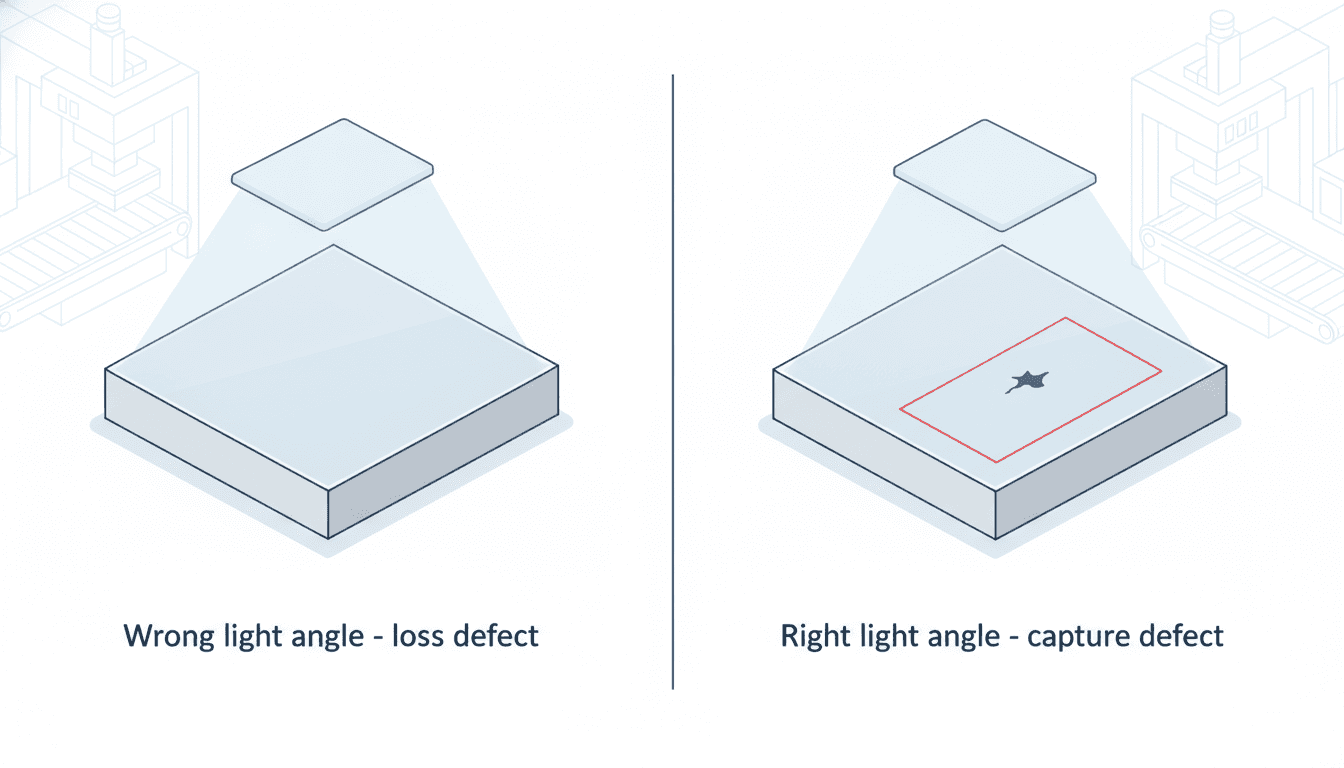
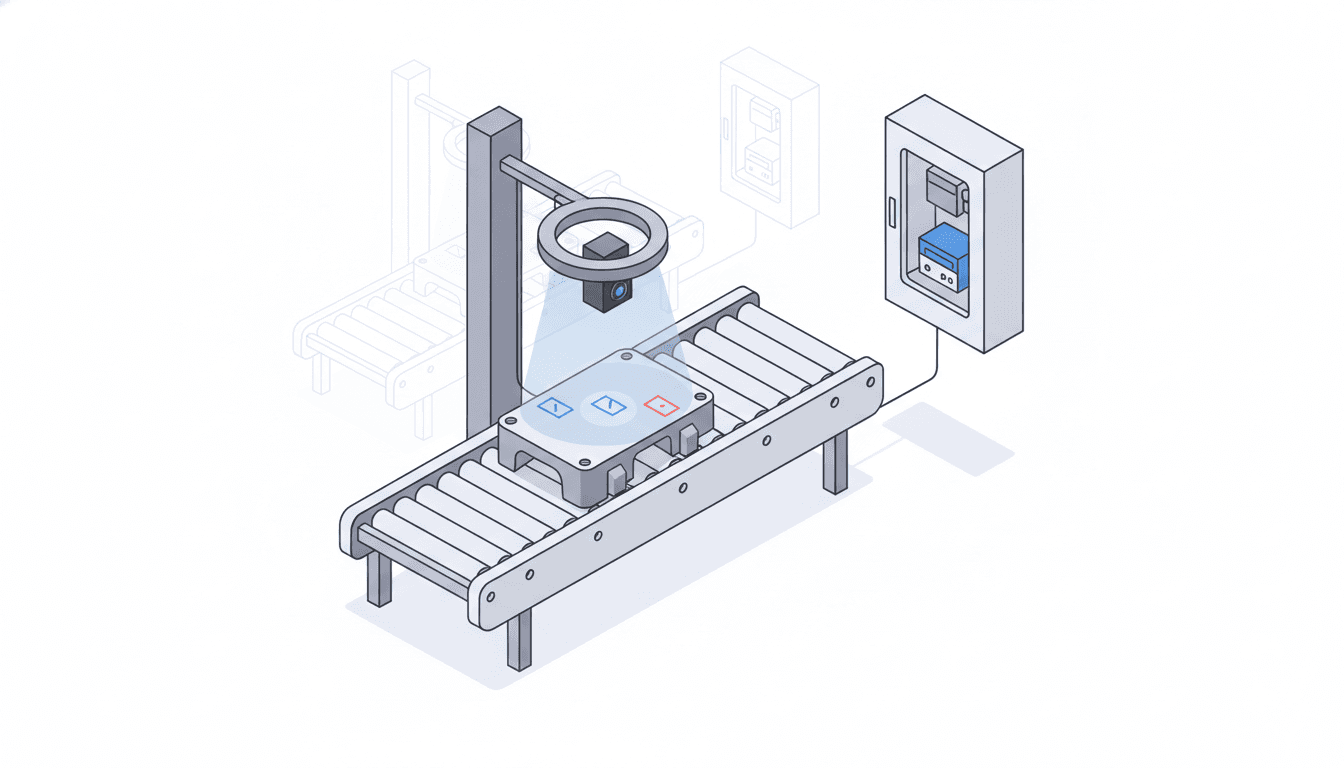
We pick the camera, lens and illumination to make your defect physically visible — then build and mount the cell to survive your plant.
Where pilots die: The fault was never in the picture. No model can recover what the sensor never saw but it will give a confident answer anyway.
Area / line scan · telecentric & macro optics · dome, dark-field, backlight · IP65–IP69K
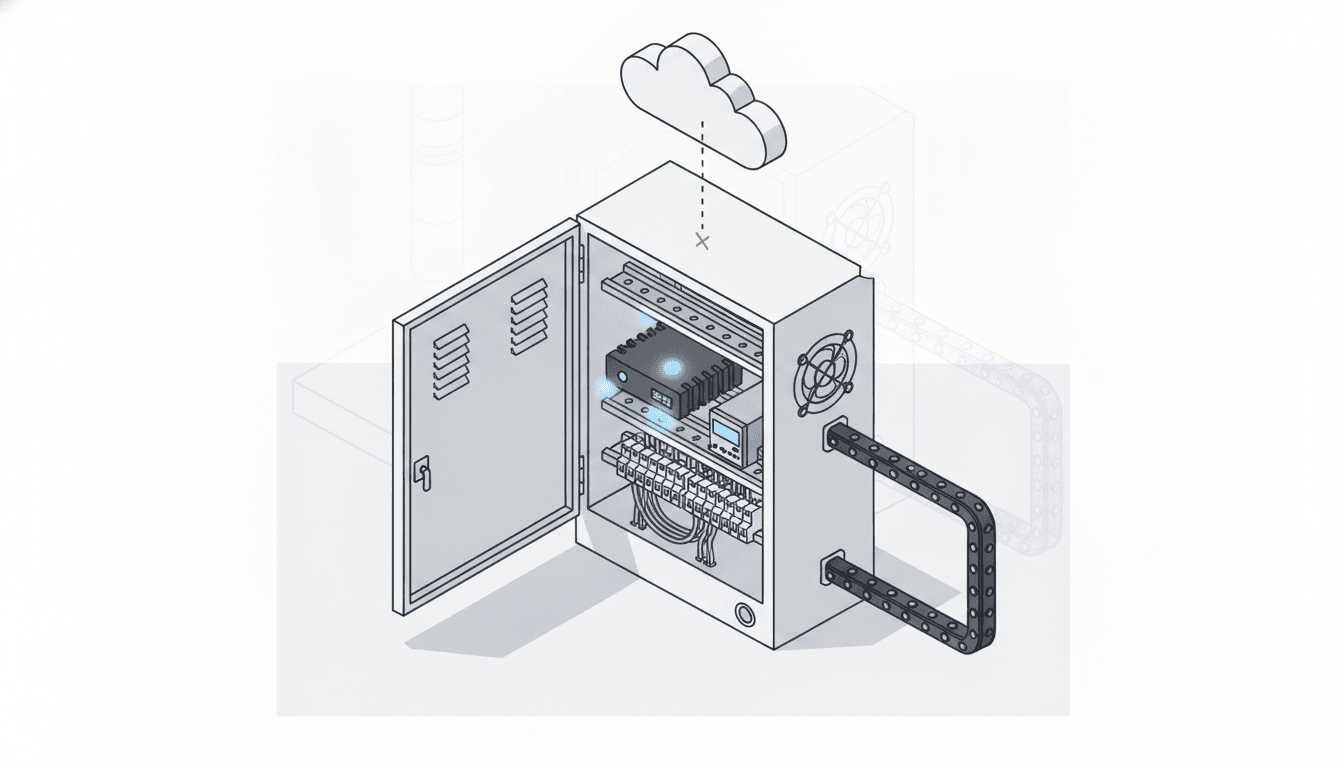
Models trained on your parts are running alongside the machine. No cloud in the control path, deterministic latency, full function in a network outage.
Where pilots die: It ran in a laptop, not on the line. A workstation demo tells you nothing about cycle time, panel space, heat or a WAN drop at 2 a.m. on B shift.
NVIDIA Jetson · Intel OpenVINO · Hailo · industrial PC · air-gapped capable
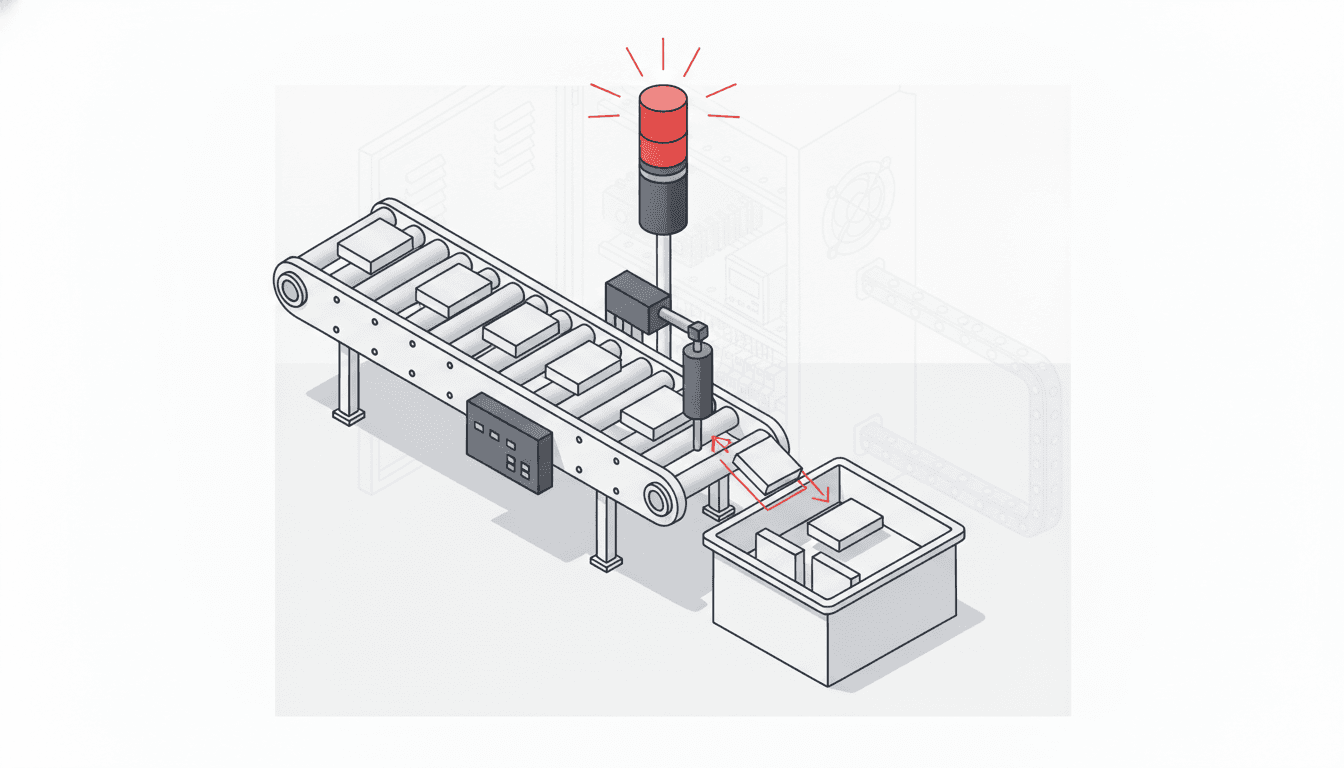
A verdict is no dashboard. Rejects drive a PLC output, diverter or andon within the cycle — and the record is input into your quality system.
Where pilots die: The verdict went to a dashboard no one opened. If a reject has no in-cycle output, the system is just a screen saver.
Digital I/O · OPC-UA · Profinet · Modbus TCP · MQTT · MES / QMS write-back
Before you buy anything
Prior to making any purchases, there are two categories of issues. Two types of cameras. Some of what you want is already on your CCTV footage. The rest needs optics to be built around the defect. Cost and timeline are defined by what side a use case falls on.
Software only. No new hardware needed. Live days.
Designed for sensors, optics, lighting and triggering. We design it, we supply it and we start it up.
Most plants require both. The feasibility study tells you which of your problems fall on which side — and what each one costs — before you spend anything on hardware.
What we deliver
Delivered as a single scope of work – so there is no one to point to when the queue stops.
Cycle errors
Existing CCTV camera on your
The verdicts to root cause
Multi-plant, multi-line
Applications & industries
Choose your queue. Each one shows what is caught, where the money leaks out today, and the cell we would build for it.
Both the weld pore and the missing clip leave the plant as a warranty claim. We catch them at the station that made them. In cycle, before the body moves on.
Cell12 MP area scan · blue low-angle + diffuse dome · IP65 · PLC-triggered on part-in-position
Where the money is
Sampled audit at the end of the line
Every part, judged at the weld station
Pays back through: rework hours, warranty claims and final-audit line stops.
Your rupee figure is modelled from your own scrap, rework and warranty numbers during Assess & Feasibility.
| Part ID | Inspection result | Severity |
|---|---|---|
| BR-091 | Weld porosity | Critical |
| BR-092 | Fully conforming | None |
| PN-238 | Panel gap out of tol. | Level 2 |
| PN-241 | Surface dent | Level 1 |
| SA-118 | Missing clip (pos 4) | Critical |
| SA-119 | Weld spatter | Level 1 |
Illustrative output. Detection performance is measured on your parts during feasibility.
If it is wound and a scratch is found it is a downgrade. It is a process correction, found while it runs. We show live grade and pin every defect to the meter and lane.
CellLine scan with encoder sync for coil · switchable dark-field, coaxial and low-angle for discrete parts · vibration-isolated mount
Where the money is
Coil graded after it is already rolled
Defect mapped to metre and lane as it runs
Pays back through: downgraded coil, customer returns and re-rolling cost.
Your rupee figure is modelled from your own scrap, rework and warranty numbers during Assess & Feasibility.
| Part / Coil | Inspection result | Severity |
|---|---|---|
| CS-118 | Casting porosity | Critical |
| CL-3301 | Rolling mark | Level 2 |
| MP-402 | Burr at edge | Level 1 |
| CS-121 | Cold shut / lap | Critical |
| CL-3305 | Surface scratch | Level 1 |
| MP-407 | Within tolerance | None |
Illustrative output. Detection performance is measured on your parts during feasibility.
A missed particle at dicing becomes scrap after packaging when the part is worth several times more. We inspect every wafer, die and panel, not just a sample.
CellHigh-magnification telecentric · coaxial + dark-field · vibration-isolated · cleanroom-rated enclosure
Where the money is
Manual review of selected wafers and panels
Every wafer, die and panel, at speed
Pays back through: yield loss carried forward into packaging and assembly.
Your rupee figure is modelled from your own scrap, rework and warranty numbers during Assess & Feasibility.
| Wafer / Panel | Inspection result | Severity |
|---|---|---|
| W-2207-04 | Particle cluster | Critical |
| W-2207-09 | Micro-crack | Critical |
| D-4412 | Die chipping | Level 2 |
| LP-0881 | Mura (regional) | Level 2 |
| LP-0884 | Dead pixel cluster | Level 1 |
| W-2207-12 | Clean — pass | None |
Illustrative output. Detection performance is measured on your parts during feasibility.
A solder bridge caught at functional test costs you a rework station. You're in the field; you lose the customer. We test every board before it goes to test.
CellMulti-angle RGB dome with coaxial and low-angle rings · telecentric lens · conveyor-triggered on board-present
Where the money is
Defects surface at end-of-line functional test
Every board judged before it reaches test
Pays back through: test-stage failures, rework labour and field returns.
Your rupee figure is modelled from your own scrap, rework and warranty numbers during Assess & Feasibility.
| Board ID | Inspection result | Severity |
|---|---|---|
| PB-4417-02 | Solder bridge (U3) | Critical |
| PB-4417-05 | Missing capacitor C14 | Critical |
| PB-4417-08 | Tombstoned R22 | Level 2 |
| PB-4417-11 | Insufficient paste | Level 1 |
| PB-4417-14 | Reversed diode D2 | Critical |
| PB-4417-17 | Pass — all nets | None |
Illustrative output. Detection performance is measured on your parts during feasibility.
If you count scrap at the end of a shift you don't know which cavity made it. Each reject we have had its tool, cavity and shot number so the fix is a process change, not a guess.
CellBacklight for silhouette + dome for surface · triggered on mould-open / part-eject · cavity ID carried from the IMM
Where the money is
Scrap counted once, cause already gone
Reject tied to tool, cavity and shot number
Pays back through: material scrap, tool downtime and repeat cavity faults.
Your rupee figure is modelled from your own scrap, rework and warranty numbers during Assess & Feasibility.
| Cavity | Inspection result | Severity |
|---|---|---|
| CAV-4 | Short shot | Critical |
| CAV-4 | Sink mark | Level 2 |
| CAV-1 | Flash at parting line | Level 1 |
| CAV-2 | Within spec | None |
| CAV-3 | Silver streaking | Level 1 |
| CAV-6 | Burn mark / gas trap | Level 2 |
Illustrative output. Detection performance is measured on your parts during feasibility.
If your customer finds a pinhole, that is a claim. It is a trim found on the winder. We grade the web across its full width as it runs, and mark each defect to metre and lane.
CellMulti-head line scan, full web width · transmitted and reflected illumination · encoder-synchronised acquisition
Where the money is
Roll graded later on an inspection table
Every metre graded as the web winds
Pays back through: rejected rolls, customer claims and re-winding time.
Your rupee figure is modelled from your own scrap, rework and warranty numbers during Assess & Feasibility.
| Roll ID | Inspection result | Severity |
|---|---|---|
| WR-5510 | Pinhole (lane 3) | Critical |
| WR-5510 | Gel / fisheye | Level 2 |
| WR-5512 | Coating streak | Level 2 |
| WR-5514 | Edge tear | Critical |
| WR-5515 | Bubble inclusion | Level 1 |
| WR-5517 | Grade A — clean | None |
Illustrative output. Detection performance is measured on your parts during feasibility.
A drop stitch found at the inspection table has already lost the roll for you. We flag it on the machine while the cloth is still running, and point back to the needle that caused it.
CellLine scan with diffuse dome · encoder-synced to fabric take-down · sealed lint-tolerant enclosure with air purge
Where the money is
Roll graded once it leaves the machine
Fault flagged while the roll is still running
Pays back through: downgraded fabric, cut-and-sew waste and repeat needle faults.
Your rupee figure is modelled from your own scrap, rework and warranty numbers during Assess & Feasibility.
| Roll ID | Inspection result | Severity |
|---|---|---|
| R-1182 | Hole / broken yarn | Critical |
| R-1182 | Oil stain | 4 points |
| R-1183 | Drop stitch | 2 points |
| R-1183 | Barré / shade band | 4 points |
| R-1184 | Slub | 1 point |
| R-1185 | Clean — Grade A | None |
Illustrative output. Detection performance is measured on your parts during feasibility.
If an empty blister cavity gets into the market, it's a recall. We inspect each pack, not an AQL sample, and all verdicts are captured for audit.
CellHigh-speed area scan strobed to freeze motion · backlight for fill and cap seating · IP65 washdown · validation docs in scope
Where the money is
Sampling plan plus an operator eyeball check
Every blister, vial and carton, with an audit record
Pays back through: batch holds, deviations, re-inspection labour and recall exposure.
Your rupee figure is modelled from your own scrap, rework and warranty numbers during Assess & Feasibility.
| Pack ID | Inspection result | Severity |
|---|---|---|
| BL-0912 | Empty blister cavity | Critical |
| BL-0918 | Broken tablet | Critical |
| VL-3341 | Under-fill | Level 2 |
| VL-3346 | Cap not seated | Critical |
| CT-7720 | Label skew > 2 mm | Level 1 |
| CT-7724 | Lot / expiry legible | None |
Illustrative output. Detection performance is measured on your parts during feasibility.
Under-fill is a giveaway, over-fill is a rejection by the retailer and an unreadable date code is a return. We check every single unit before it goes onto a pallet.
CellArea scan with high-power strobe and backlight · IP69K stainless washdown · heated window against condensation
Where the money is
Periodic checkweigher and manual checks
Every unit verified before palletising
Pays back through: overfill giveaway, retailer rejections and complaint handling.
Your rupee figure is modelled from your own scrap, rework and warranty numbers during Assess & Feasibility.
| Unit ID | Inspection result | Severity |
|---|---|---|
| BT-2201 | Foreign object detected | Critical |
| BT-2204 | Under-fill −12 ml | Level 2 |
| BT-2209 | Cap seal incomplete | Critical |
| BT-2213 | Date code unreadable | Level 1 |
| BT-2216 | Label misaligned | Level 1 |
| BT-2220 | Pass — all checks | None |
Illustrative output. Detection performance is measured on your parts during feasibility.
A needle burr that arrives at a patient is a field action. We examine every unit under magnification, and record the record right into your design-history file.
CellTelecentric with collimated backlight · diffuse front light for bond lines · cleanroom-compatible · validated change control
Where the money is
Sampled manual review under magnification
Every unit, with a record for the design-history file
Pays back through: non-conformance investigation, scrapped lots and field actions.
Your rupee figure is modelled from your own scrap, rework and warranty numbers during Assess & Feasibility.
| Unit ID | Inspection result | Severity |
|---|---|---|
| SY-1102 | Needle tip burr | Critical |
| SY-1108 | Barrel crack | Critical |
| CT-0455 | Weak tubing bond | Level 2 |
| IV-7781 | Seal channel in pouch | Critical |
| DG-2290 | UDI label unreadable | Level 1 |
| SY-1115 | Pass — all checks | None |
Illustrative output. Detection performance is measured on your parts during feasibility.
Every no-read becomes a person who walks a parcel to an exception desk. We recover damaged, angled and glossy codes which your fixed scanners give up on.
CellMulti-head tunnel over the conveyor · high-power strobe for motion freeze · angled top and side heads · calibrated dimensioning
Where the money is
Failed scans diverted to manual exception handling
Damaged, angled and glossy codes read in the tunnel
Pays back through: manual exception handling, mis-ships and claims.
Your rupee figure is modelled from your own scrap, rework and warranty numbers during Assess & Feasibility.
| Shipment | Inspection result | Severity |
|---|---|---|
| PKG-88219 | Carton crushed | Critical |
| PLT-1104 | Case count short −2 | Critical |
| PKG-88214 | Barcode unreadable | Level 2 |
| PKG-88240 | Leak detected | Critical |
| PKG-88231 | Label misapplied | Level 1 |
| PKG-88245 | Pass — dispatch OK | None |
Illustrative output. Detection performance is measured on your parts during feasibility.
The shelf is empty, your system says it is not, so nobody refills it and the sale is lost. We watch the shelf, the queue and the checkout while the shopper is still in the store.
CellShelf-facing cameras · your existing ceiling cameras for queue and floor · normal store lighting · one box on site, no faces stored
Where the money is
Aisle walked when someone has a spare minute
Empty shelf, long queue or missed scan, flagged at once
Pays back through: sales lost to empty shelves, shoppers who give up on the queue and items that never get scanned.
Your rupee figure is modelled from your own lost-sale, stock-loss and queue numbers during Assess & Feasibility.
| Zone | Inspection result | Severity |
|---|---|---|
| TILL-02 | Queue 9 deep — 7 min wait | Critical |
| AISLE-04 | Shelf empty — system says in stock | Critical |
| SELF-03 | Item bagged, never scanned | Critical |
| FLR-03 | Spill on floor — 4 min | Level 2 |
| AISLE-07 | Product in wrong place | Level 1 |
| AISLE-11 | Shelf full — no action | None |
Illustrative output. Detection performance is measured on your parts during feasibility.
01 / 12 · Automotive
Deployment architecture
Four layers, clean interfaces, no hidden cloud dependencies in the control plane.
The reject decision never leaves layer 02. If the platform, the WAN or the cloud is unavailable, the cell keeps inspecting and keeps rejecting — it simply queues its records until the link returns.
How we deliver
A decision gate at each step. You can leave at the end of any phase.
≈ 1 week
We walk the line with your quality and maintenance teams, define the classes of defects that matter, and baseline what poor quality costs you today.
2–3 weeks
Imaging experiments on your physical samples. We test camera, lens and lighting combinations until we can reliably see the defect, then train and measure a model for it.
4–6 weeks
One line, fully commissioned. Cell installed, PLC wired, operators trained. It sits next to your existing QA so you can compare the verdicts before trusting it.
Staged
The cell design is proven and replicated line by line, plant by plant on one platform. Line nine is a repeat build, not a new project.
Ongoing
Drift monitoring, retraining when parts and tooling change, spares and SLA-backed support, or full transfer to your team, with the training to run it.
Acceptance criteria for the pilot are written from the numbers measured in phase 2 — not from a sales promise.
Security, privacy & compliance
Vision systems see people and proprietary product. Both ask questions that should be asked before, not after, procurement.
Images, labels and model weights stay yours
Zero outbound connectivity option
Anonymised inference, on-device face blurring
Immutable log of every verdict and change
Versioned models, one-click rollback
SSO, RBAC and network segmentation
Full security documentation, DPA and works-council pack available on request — and we support your own pen-test and vendor review.
FAQ
Yes, for safety and compliance work — PPE, restricted zones, proximity, smoke and spills, and that can be deployed in days without new hardware. No, not generally for defect inspection. A CCTV camera is the wrong resolution, the wrong lens, uncontrolled ambient light and no synchronisation with the part passing by, so the defect is often not in the image at all. No model can retrieve information that the sensor has never seen. We’d rather tell you that up front than sell you a pilot that fails quietly.
Good question and one we’d rather answer than duck. We are early — so the engagement is structured so you never have to take a big step on faith. A feasibility is a small, fixed scope piece of work that results in a written report. This includes the defects that we were not able to detect. The pilot is one line with acceptance criteria you agree in advance and runs in parallel to your existing QA, not replacing it. You own the images, the labels, and the model weights throughout, and the cell hardware is standard industrial equipment that another integrator could support. When you’re wrong about your application, you learn within weeks for a small amount of money — not year two.
Yes, we do. We design the cell, source the cameras, optics, illumination, enclosure and edge hardware, build and commission it and hand over a working system all under one commercial scope. During feasibility you get an itemised bill of materials so you won’t be surprised at anything about the cost. If you’d prefer to buy the hardware yourself to our specification, we’re happy to support that too.
So that’s why the feasibility phase is so important. You send out physical samples over good parts and every failure mode. We run imaging trials until the defect is reliably visible, train a model, and report precision and recall measured per defect class on a held-out set — not one headline percentage. If a defect class is not reliably detectable, that goes in the report as well. The acceptance criteria for the pilot are then written from those measured numbers and not from a sales promise.
How much depends almost entirely on the optics your defect needs — a presence/absence check and a sub-millimetre surface inspection are different orders of magnitude and you can’t honestly quote either from a website. But the commercial shape is consistent, with a one-time charge for the vision cell and commissioning, followed by an annual support-and-model-maintenance charge. At the end of feasibility, before any capital is committed, you will have an itemised bill of materials and full cost breakdown. Give us a call and on the first call we will give you a realistic range for your particular application.
For a stable, high-volume part, with well-defined geometric rules, a traditional rule-based system is often the right answer and we will say so. In cases of variable, cosmetic or hard to describe defects as a rule — stains, textures, weld appearance, organic shapes, mixed product — and where new variants would otherwise mean reprogramming every time, AI earns its place. We build both and the recommendation comes out of what is feasible rather than out of what we would prefer to sell.
New variants are done by collecting images and retraining, usually without touching the hardware if the part envelope is similar. Models are versioned, validated prior to release and rollback capabilities are built in. Under a managed service we look out for drift and we take care of retraining as part of the SLA. Under a capability transfer we train your engineers to do it, and you keep the tooling and the weights.
Yes. Both inference and reject decision are running on the edge device at the cell, so there is no dependency on the cloud in the control path. If the platform or WAN is unreachable the cell continues to inspect and reject, buffering its records locally and syncing when the link is restored. Full air-gap deployments supported.
Safety detection doesn’t have to identify anybody. Models operate on anonymised inference, on-device face blurring can be turned on before any frame is saved, retention periods are adjustable, and access to evidence clips is role-restricted and logged. We are happy to participate in that review directly with your HR and legal teams.
Annual support contract covering monitoring of model performance, retraining, platform updates, hardware spares and defined response times. Remote support and on-site attendance as required by the contract. Or we do a build-operate-transfer engagement, where we operate the system while your team learns and then we transfer ownership of the system, the models and the documentation.
Start here
Send 30-50 samples of your good parts, your failure modes. We do imaging trials, train a model, and come back with what we measured, including the cases where the answer is no.
Contact
Not a form that routes to a sales queue. Tell us the part, the defect and the line speed, and someone who has built these cells will come back — usually within two working days.
support@360vision.ai
+1 (213) 316-9787
Coimbatore, Tamil Nadu, India
Tampa, Florida, USA
Ship 30–50 parts covering good units and each failure mode.
We'll send a shipping address and an NDA on request.